
Lupine Consulting - Applied Cognitive Linguistics
Computational cognitive linguistics is a new type of computational linguistics. Built from the ground up on a relatively new (20 - 30 years old) understanding of language. Currently it is the most advanced tool-set available to get insights about the perspective of the person or people behind any block of written text.
What it is NOT |
What it IS |
|
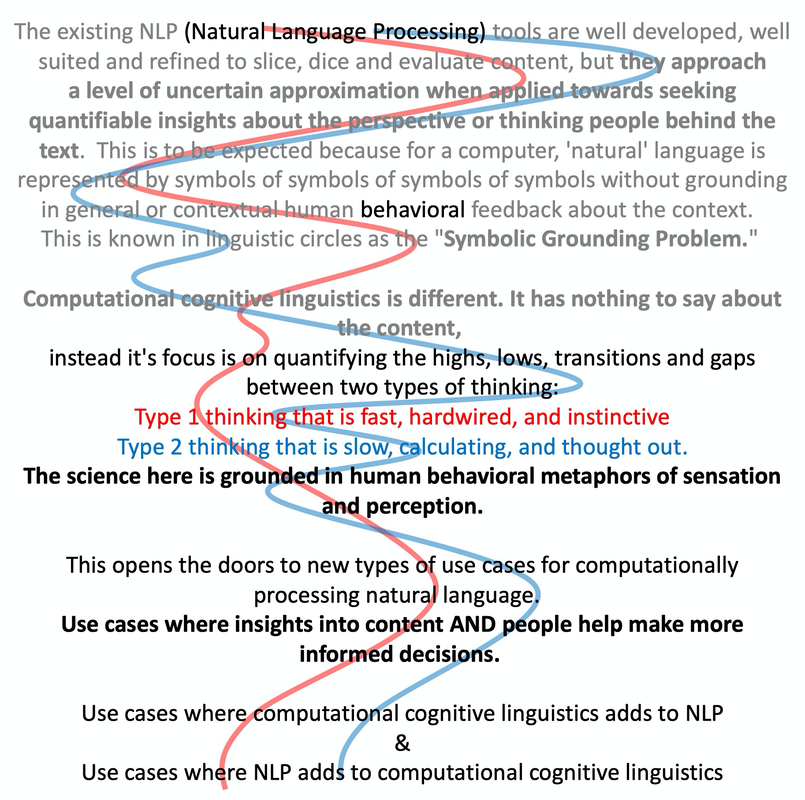
Popular computational linguistic approaches under the general moniker of NLP (Natural Language Processing) tools based on machine learning, artificial intelligence, training sets, dictionaries, parse-trees, word-to-vec, doc-to-vec, feature matrices, word proximities, bayesian stats, naive-bayesian maths and all such approaches, with multiple coding packages in most of the popular coding languages, have been around for a long time and are great tools to evaluate content. Computational cognitive linguistics is different and separate from the above - it has nothing to say about the content. By contrast, it sheds light on how the people writing the text are perceiving the content.
|
Cognitive linguistics has it's roots in the science of Embodied Cognition. Prior to the the development of embodied cognition, cognitive processes, including language, were thought to be primarily mental and conscious processes. Words were assumed to have rather fixed dictionary meanings and language followed rather fixed syntactic rules. Research in this field over the last 30 years has now proved what was common sense all along - that the meaning of a word, sentence or part of text depends on what was written before and what follows - the cliché "it depends" - really does hold true.
Computational cognitive linguistics is a set of algorithms that use shifts in the micro and macro framing of the context to define meaning at each point in a piece of text or conversation, as perceived by the people behind the words. |
How do these new algorithms give insight into the people behind the text?
Our algorithms use 'fuzzy dictionaries' that relate language patterns to basic behaviors. Next reverse Markov chains are used to determine relative importance of parts of text depending on ‘how’ they are framed, what comes before and what comes after a word, phrase, group of words or sentences. This enables the algorithms to be sensitive to changes in context when categorizing the perception or thinking of the people behind the text. They are made to bring about an understanding of the perspective of the person or people who wrote the text, not the content of the text.
Using a framework introduced in the 2011 book “Thinking Fast & Slow” by Nobel Laureate Daniel Kahneman, the algorithms categorize cognition as being of two primary types, namely, Type 1 thinking that is fast, hardwired, and instinctive, and Type 2 thinking that is slow, calculating, and thought out.
The algorithm then computes the ebb & flow of the probability of these two types of cognition or two types of thinking over a block of text.
The highs, lows, transitions and gaps between these two types of thinking give quantifiable insight into the people behind the text.
Using a framework introduced in the 2011 book “Thinking Fast & Slow” by Nobel Laureate Daniel Kahneman, the algorithms categorize cognition as being of two primary types, namely, Type 1 thinking that is fast, hardwired, and instinctive, and Type 2 thinking that is slow, calculating, and thought out.
The algorithm then computes the ebb & flow of the probability of these two types of cognition or two types of thinking over a block of text.
The highs, lows, transitions and gaps between these two types of thinking give quantifiable insight into the people behind the text.
With these new algorithms, we can begin to grasp the non-verbal, from the verbal
.
If you seek insights into content AND people from text - we should talk!
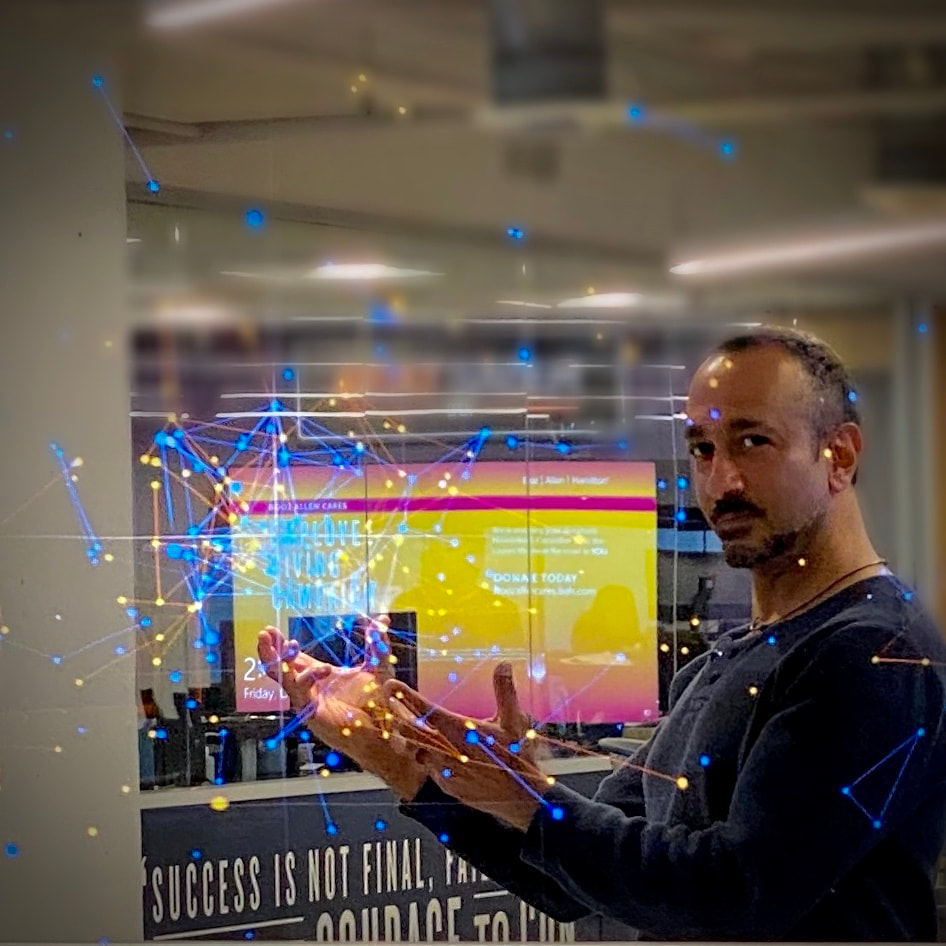
Engaging with Lupine Consulting is easy. The "royal we" here is Manu Rehani + Austin based experts in Python, Ruby, C + upwork based Stanford and MIT grad students with expertise in R, Tableau, Python, SAS, Data Science, AI & ML.
The process is simple:
The process is simple:
- Drop me a note at consulting@lupine.is
- We'll talk to understand what you'd like to achieve and scope out what Lupine can and cannot not do for you
- We'll put a project team and budget together and go from there